Monday, 28 July 2014

Yogic Chart - Healthy Yoga Postures, Yogic Chart for Heart - English

If you have planned to take up yoga, then you will also have to take up the yoga diet that consists of integral yoga natural foods. Yoga diet involves eating at the right time in the right propotions, the right kind of food that would give you all the necessary vitamins and minerals.

The body needs food containing for the right balance of carbohydrates, proteins, fats, vitamins minerals and salts. Water is needed to help digestion and assimilation. Food in the form of Nourishment is finally assimilated in various forms throughout the body. Do not eat when emotionally disturbed. While dining, talk well and eat wisely. Moderate and nourishing food is essential to maintain vigour, strength and alertness. Avoid fasting

Principles of yoga wholefood diet suggests that diet must also be regulated. Vegetarians can carry on with their usual food reducing excess spices, oily and rich foods. These things can be reduced gradually and whenever possible eliminate completely once and for all.

All kinds of Non-vegetarian food like meat, eggs and fish must be totally avoided So also alcohol drinks. Freshly cooked vegetables, freshly cooked foods, plenty of fruits and milk are the best foods for practicing yoga.

By moderation in eating and resting, by regular working hours and by the right balance Between sleeping and working, yoga destroys all pain and sorrow. Yoga is working wisely and living a skilful active life in harmony and moderation.

Heart Disease, Yoga and Your Heart - English

Although even doing one or two poses can be effective, Chryssicas says practicing a heart-healthy yoga work out will yield the most results.

This routine takes just 20 minutes, which Chryssicas says is the perfect amount of time for beginners.
Begin in Mountain pose by standing straight, feet about hip-width apart and your hands either at your sides. Raise one foot at a time, spreading your toes wide before placing them back on the floor. Distribute your weight evenly across the bottom of each foot so you feel grounded, not leaning forward or back. Exhale.
Inhale while sweeping your arms out to the sides and high overhead, into Overhead Reach until your palms are together. Stretch upward, allowing your chest to expand. Then arch backward (but only as far as you're comfortable so you don't lose your balance) and look up at your hands. Hold that position for a few seconds while holding your breath.

Exhale and gently bend, or fold, at the waist as far forward (into Forward Fold) as comfortably possible keeping your back straight. Grasp the back of your legs (anywhere from the ankles to the thighs), bend your elbows and very gently tuck your chin to your chest and move your upper body toward your legs. Hold for a few breaths and slowly return to a standing position.

Step your right foot forward. Bend your right knee (into a High Lunge position) and keep it directly over your right ankle. Lean forward and press your fingertips or palms into the floor in line with your forward foot. Roll your shoulders down, pressing your chest forward while looking straight ahead. Relax your hips letting them sink toward the floor while straightening your back leg as much as comfortably possible and rest your back knee on the floor if you need some extra balance. Hold for a few breaths.

Saturday, 26 July 2014

Ustrasana - Camel Pose, Yoga Exercise for Heart - English

This is a graceful backbend that stretches and opens your entire body, particularly the frontal region. The neck, chest and quadriceps derive most of the benefit of this posture. Not only does it develop these regions, but it also works on and strengthens your back, significantly improving posture. If executed perfectly it can act as a stimulant for the abdominal organs, relieve menstrual pain, fatigue and indigestion, and ease back aches and pains.

Sarvangasana - Shoulder Stand Pose, Prevent Heart Attacks - English

Sarvangasana :

This is a posture in which the body is lifted topsy-turvy(upside down) and entire weight of the body rests on shoulders and elbows. This is useful for all the organs of the body, hence called Sarvangasana. This is difficult to practice in the beginning; but could be taken up after practicing the Khatwangasana for a few days. Practice the posture as shown in the picture keeping the legs as straight as possible. Eyes should be closed. Breasting should be slow and normal. The posture may be retained for 30 seconds in the first week, gradually increasing by 30 seconds every week upto two minutes. It is enough if the posture is maintained for five minutes with care. No strain should be felt in the shoulders or in the neck. The lifting up of the body and brining down should be smooth without any jerks.

Friday, 25 July 2014

Pranayama - Heart Disease, Prevent Heart Attacks, Heart Diseases - English

Pranayama is the one of the eight limbs of "Hatha yoga". Often it is considered as breathing exercise, but that perception is wrong as is the case with almost every other practice of Yoga. Every practice of yoga has a very subtle effect on human consciousness and does not limit only to physical health benefits. But still, we know that breath is very vital for sustaining life.

We rarely give any thought to the breathing process of ours as it occurs automatically without our awareness and yet most of us do it incorrectly. Now if breathing is a natural spontaneous process in our body, than how can we do it incorrectly? The answer is that due to continuously breathing in incorrect patterns, our respiratory muscles have become lazy and inefficient.

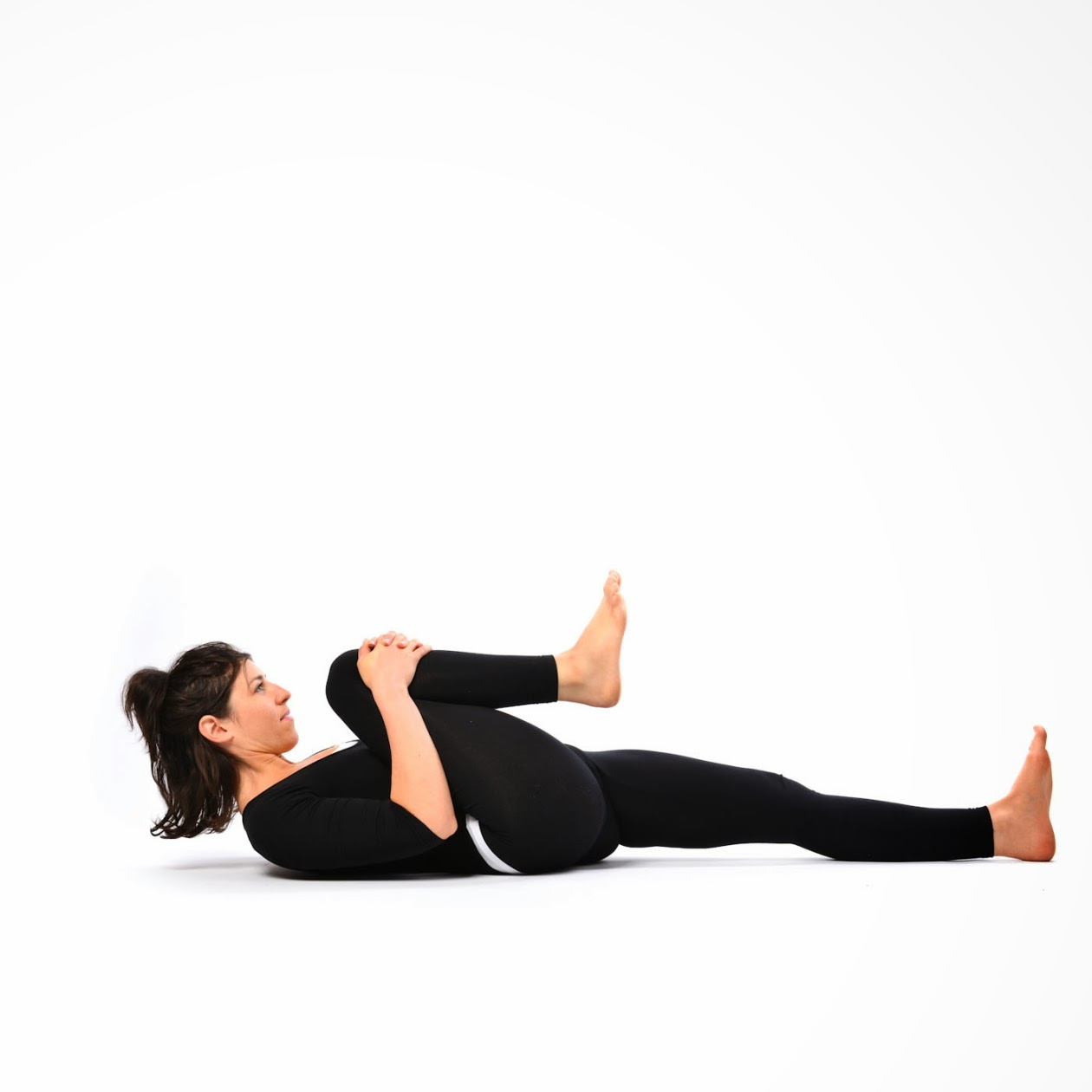
Pawanmuktasana - Yoga for Stomach, Exercises for Digestive Organs, Heart Diseases - English

Begin by lying in Shavasana (Supine Base Position)
Bend the right knee and bring the thigh to the chest.
Interlock fingers and clasp the hands on the shi njust below the right knee.
Keep the left leg straight and on the ground.
Inhale deeply, filling the lungs as much as possible.
Holding the breath, raise the head and shoulders off the ground and try to touch the right knee with the nose.
Remain in the final position for a few seconds, retaining the breath and counting mentally.
While slowly exhaling, return to the supine base position.

Benefits: 

 This pose strengthens the lower back and loosens spinal vertebrae. It massages abdominal muscles thus aiding digestion.

Practice Note:

Ensure that the straight legs remains in contact with ground. If this is difficult or there is discomfort in the low back, bend the knee of the passive leg and placing the foot on the floor to modify the practice.

Thursday, 24 July 2014

Nutritional Management for Heart - Diet, Control Heart Diseases - English

Nutrition management is fundamental for the prevention of type 2 diabetes and effective management of type 1 and type 2 diabetes. The aim is for people with diabetes to obtain the knowledge, skills and confidence to make appropriate food choices to reduce risk, improve glycaemic control and quality of life.
With new diagnostic criteria anticipated to increase the number of people diagnosed with diabetes in the UK by a third, structured evidence-based dietary education will be an effective way to save on medical costs for prescription drugs.1

Nutrition
Nutrition therapy has led to reductions in HbA1c of 1-2 per cent in people with newly diagnosed and existing type 2 diabetes.2 Dietary interventions can improve glycaemic control whilst also halting and even reversing progression of beta-cell failure and insulin resistance, thus reducing medication use in type 2 diabetes.3-5 Nutrition therapy can result in reduced health service utilisation and costs, and the savings may actually exceed the cost of providing the service.1,6
Intensive nutrition therapy has resulted in weight loss and improved glycaemic control at six months,5 12 months3 and four years.7 When insulin resistance dominates, weight loss is an effective strategy that increases insulin sensitivity, improving glycaemic control.